


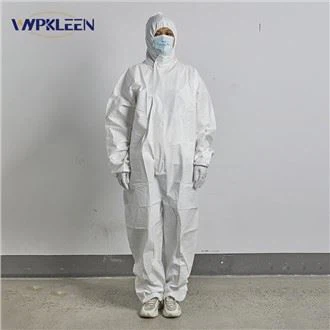
Disposable protective clothing is an essential component of PPE for professionals working in a number of industries and environments, including medical, laboratory, municipal and utility, food service, janitorial, construction, painting, and many others.Disposable protective suits provide a barrier against specific types of substances, from dry dirt and dust to liquid spill, splash, and spray including hazardous materials and contaminants. Single-use or limited-use work suits and other garments are intended to provide safe and sanitary protection for the wearer and others with whom they may come in contact, while also helping to maintain a standard of cleanliness when transitioning from a work environment to other spaces.
Advantages of Disposable Protective Clothing
Enhanced Protection
Disposable protective clothing provides an additional layer of protection against workplace hazards. Whether it's exposure to chemicals, biological agents, or airborne particles, these garments act as a physical barrier, reducing the risk of direct contact and potential contamination. With specialized designs for different applications, disposable protective clothing can offer specific protection against chemical splashes, biohazards, particulate matter, and more.
Convenience and Ease of Use
One of the key advantages of disposable protective clothing is its convenience and ease of use. Unlike reusable garments that require cleaning, maintenance, and storage, disposable clothing eliminates the need for laundering or decontamination after use. Workers can simply discard the used garment, saving valuable time and effort. This convenience is particularly beneficial in industries where frequent garment changes are necessary, such as healthcare, pharmaceuticals, and manufacturing.
Cost-Effectiveness
Disposable protective clothing can offer cost advantages over reusable options. While the upfront cost of disposable garments may be higher, they eliminate the expenses associated with laundering, repair, and replacement of reusable clothing. Additionally, disposable clothing reduces the risk of cross-contamination between different work areas or processes, minimizing the potential costs associated with contamination incidents, product recalls, or workplace accidents.
Hygiene and Infection Control
Maintaining high levels of hygiene is crucial in industries where contamination or infection risks are prevalent. Disposable protective clothing plays a vital role in ensuring hygiene and infection control standards are met. By using single-use garments, the risk of carrying pathogens or contaminants from one area to another is significantly reduced. This is particularly vital in healthcare settings, laboratories, food processing, and cleanroom environments.
Versatility and Adaptability
Disposable protective clothing is available in a wide range of styles, sizes, and materials to suit different industry requirements. From coveralls and gowns to shoe covers and bouffant caps, these garments can be tailored to various applications and workplace environments. Their versatility makes them suitable for use across industries such as healthcare, manufacturing, construction, laboratories, and more.
Reduced Contamination Risks
Disposable protective clothing significantly reduces the risk of cross-contamination. With single-use garments, there is no potential for residual contamination from previous uses. This is crucial in environments where maintaining sterile or controlled conditions is paramount. By minimizing the risk of contamination, disposable clothing helps protect products, processes, and individuals, maintaining the integrity and safety of the working environment.

Why Choose Us
Our products
Our products mainly cover Industrial Non-woven Wipers, Household Wipes, Medical Wipes, Beauty Care products, etc.
Sales team
We own a professional sales team who can service you within 24 hours.We are sure any of your inquiry will get our prompt attention and reply.
Products applications
We are a professional factory dedicated to the research and development, production, sales, and OEM service of nonwoven cleaning products which are widely used in Automotive Refinishing, Aerospace, Hospitality and Food Service, and Industrial and Manufacturing Cleaning.
Our service
We not only provide professional nonwoven solutions, but also established a perfect after-sales system, we promise to feedback to our customers in 24 hours.
Key Factors to Consider When Choosing Disposable Protective Clothing
Material
There are three types of materials commonly used for disposable protective clothing. Spunbond Meltblown Spunbond (SMS) fabric is a three-layer nonwoven fabric. Microporous film (MPF) is also a non-woven laminated fabric, which is a non-woven fabric composed of ultra-fine continuous flash-spun polyethylene fibers.
Hair shedding characteristics
One of the challenges with chemical disposable protective clothing is product contamination from particle shedding. These particles may come from the worker or from the disposable protective clothing itself. Different materials have different properties in terms of particle shedding. Particle shedding is particularly important in industries such as pharmaceuticals, where foreign particles can contaminate products and cause significant losses to manufacturers. Specifically, pharmaceutical companies' clean room environments have strict regulations on particle shedding and must be tightly controlled to prevent contamination.
Anti-static treatment
While many industries require the use of disposable protective clothing, some are more dangerous than others. For example, some chemical disposable protective clothing are worn in explosive environments, which poses dual risks of exposure to harmful substances and the possibility of explosion. In all cases, PPE must be dissipative and should be worn with conductive or anti-static footwear to provide the necessary grounding for good dissipation of possible electrostatic charges.
Zipper design
Zippers are a vulnerable point in chemical disposable protective clothing because liquids and solid particles can migrate through the zipper and come into contact with workers. Auto-locking zippers do not allow the zipper to open on its own while the garment is being worn, thus preventing accidental opening where hazardous materials could pass through. Diagonally sewn zipper flap guides droplets away from coverall seams.
Easy to move
Whenever the wearer of the suit moves, they may expose weaknesses in the suit by stretching the suit to the point of tearing or creating a gap between the suit and the worker. Simple actions like squatting or moving your head are prime examples. This challenge can be overcome through design features. Gowns made with a gusseted 3D design offer more freedom of movement than flat 2D designs and avoid tears that can occur when squatting. The three-piece hood design ensures the hood moves with the head, minimizing the risk of exposure. This design is more effective than a two-piece hood, which does not move when the wearer turns their head.
Sewing and gluing
Each stitch in the suit leaves a hole in the garment where dust or liquids can collect, especially at the seams of the waist elastic. The type of seam significantly affects its protective capabilities. Exterior seams provide a higher level of protection against the ingress of foreign objects than interior seams. Other options include tape. Covering sewn seams with tape makes them tighter and may even provide protection against chemical penetration. But only tight seams can maintain the integrity of the garment and protect workers from harmful substances. If the seams are not excessively glued, it is recommended to reduce the number of seams sewn. Using glued waist elastic instead of sewn waist elastic preserves a better fit while eliminating the need for long sewn seams in the back.
Types of Disposable Protective Clothing
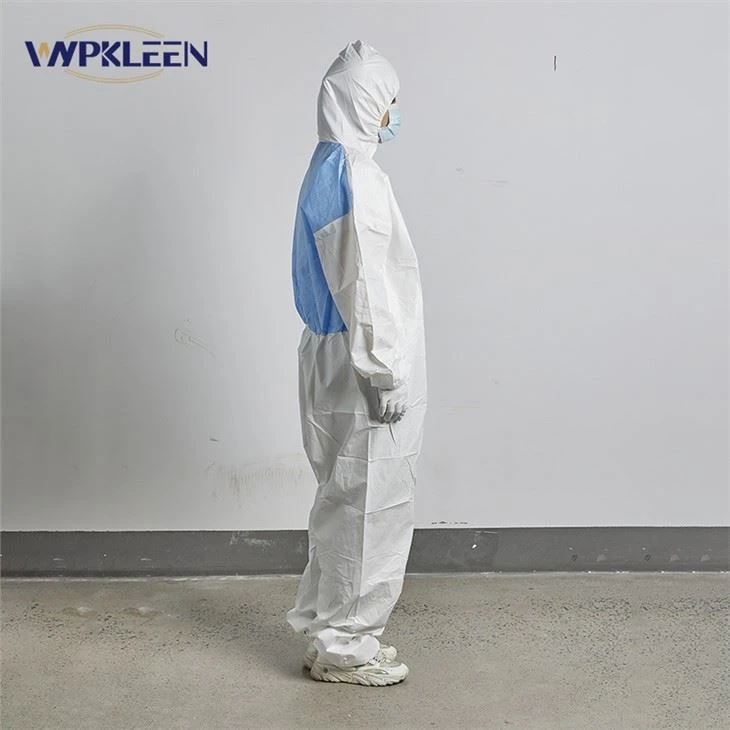


Disposable protective clothing ranges from positive pressure airtight anti-permeability protective clothing with high protective performance to ordinary particulate protective clothing. The performance of various types of protective clothing is quite different, and the scope of application is also different. From the style point of view, protective clothing is divided into one-piece, split and skirt structures. The material and performance are different, divided into one-time use and repeated use. Disposable protective clothing is generally divided into four levels according to the protection level, namely:
Class A: Fully enclosed airtight protective clothing with face shield.
It can provide perfect protection to the gas and liquid in the surrounding environment. It is a set of completely enclosed, chemical-resistant clothing, gloves and boots, and a set of isolated respiratory protection devices. It is mainly used for high-level respiratory and skin hazards that exist at the same time and are in an unknown hazardous environment. And it is highly recommended to be used for the prevention and control of pneumonia caused by new coronavirus infection.
Class B: Fully enclosed non-airtight protective clothing.
When the toxic gas is not serious to the skin, it is only used for respiratory protection. Unlike Class A, it includes a set of non-enclosed, splash-proof and chemical-resistant clothing. It can provide the same liquid protection as Type A, but it is not hermetically sealed. It is mainly to protect liquid toxic substances, not gas toxic substances.And it can be used in emergency situations.
Category C: One-piece chemical protective clothing.
It includes splash-proof clothing with filter protection to completely cover the face. Medical protective clothing is the protective clothing used by medical staff and those who enter a specific medical and health area. Belongs to this level. The face protection device is N95 medical protective mask. Medical protective clothing provides barriers and protection for medical staff from contacting potentially infectious patients' blood, body fluids, secretions and airborne particles during work.
Class D: General tooling.
Limited to work clothes or other work clothes, boots and gloves attached to pants. Medical white coats (white lab coats) fall into this category.
Materials Used in Disposable Protective Clothing
Polypropylene
Polypropylene is the most commonly used material for ddisposable protective clothing. It is a lightweight, breathable, and cost-effective synthetic fabric that offers excellent penetration resistance against both water and chemicals. Polypropylene coveralls are ideal for applications that require minimal protection against hazardous materials. They are mostly used in hospitals, labs, and food processing facilities.
Polyethylene
Polyethylene is a plastic material that is known for its low cost, durability, and moisture resistance properties. It is a popular material for disposable protective clothing as it provides an impermeable barrier against water and hazardous chemicals. Polyethylene coveralls are ideal for use in wet environments, such as cleaning up spills or handling chemicals.
Microporous film
Microporous film is a breathable and lightweight material that offers superior protection against hazardous materials, including liquids, chemicals, and particulates. It is designed to allow the passage of air and water vapor while preventing the penetration of liquids and solids. Microporous film disposable protective clothing are used in industries such as pharmaceutical manufacturing, nuclear facilities, and cleanrooms.
Tyvek
Tyvek is a unique material that is created by combining polyethylene fibers. It is a lightweight, tear-resistant, and breathable material that provides an excellent barrier against water, chemicals, and particulates. Tyvek disposable protective clothing are used across a range of industries, including construction, asbestos removal, and hazardous waste cleanup.
SMS
SMS stands for “spunbound-meltblown-spunbound,” which is a type of non-woven fabric that consists of three layers. The spunbound layer provides strength and durability, the meltblown layer offers exceptional filtration properties, and the outer spunbound layer offers protection against fluids and particulates. SMS disposable protective clothing are an excellent choice for the medical, pharmaceutical, and electronics industries.
Polyvinyl chloride (PVC)
Polyvinyl chloride, commonly referred to as PVC, is a plastic material that is often used in disposable protective clothing due to its resistance to chemicals and oils. It offers an excellent barrier against liquids and particulates and is ideal for use in industries such as chemical manufacturing, petrochemicals, and oil refining.
What Is the Manufacturing Process for Disposable Protective Clothing
The first stage of the manufacturing process of protective clothing disposable is the selection of raw materials. The primary raw materials used in making protective clothing are polypropylene, which is a thermoplastic polymer, and nonwoven fabric. These materials are chosen for their lightweight and breathable properties, which make them ideal for use in sterile environments or where the risk of contamination is high. Some protective clothing may also contain additional materials such as elastic bands, zippers, and heat-sealed seams.
The next stage of the manufacturing process is the preparation of the raw materials. The polypropylene is melted and extruded into a long strip, which is then spun into fibers. These fibers are then compressed and bonded using heat and pressure to create a non-woven fabric. The fabric may go through additional treatments, such as embossing or lamination, to give it additional strength, durability, and water-repelling properties.
Once the fabric is prepared, it is cut into pieces using precise measurements. The pieces are then sewn together using specialized machines. The sewing process involves creating seams that are durable and can withstand the movements and stresses of the wearer while also ensuring the maximum protection against particles and contaminants. The seams may be heat sealed, glued, or stitched, depending on the type of protective clothing being made.
After the protective clothing are sewn together, they are inspected for any defects, such as missing stitches or tears. If any defects are found, the garment is discarded, and the process starts again. Once the garments pass inspection, they are folded, packaged, and shipped to distributors and customers.
Disposable protective clothing are also manufactured using automated machines. These machines use computer programs to cut, sew, and assemble the protective clothing, resulting in a more efficient and faster process. Automated machines are also more precise and can create protective clothing with consistent quality and fit.
The manufacturing process of disposable protective clothing is essential to ensuring their quality and effectiveness in protecting against particles and contaminants. The materials used must be of high quality, and the sewing process must create seams that are durable. The manufacturing process also ensures that the protective clothing are free from defects and meet the required standards for use in different industries.
Disposable clothing are a crucial part of PPE in many industries, and their manufacturing process plays a significant role in ensuring their effectiveness and quality. The process involves selecting high-quality raw materials, preparing them and then precisely measuring and sewing them together. The protective clothing are then inspected for defects and packaged for shipping. Automated machines may also be used to ensure faster, more efficient production. With proper manufacturing procedures, disposable protective clothing can continue to play a vital role in protecting workers from hazardous environments and promoting workplace safety.
Application of Disposable Protective Clothing
Healthcare industry
In the healthcare industry, maintaining a high level of hygiene is essential to prevent the spread of infections and keep patients' safe. Disposable protective clothing is widely used in this industry to ensure the safety of healthcare workers and patients. Disposable medical aprons, gloves
and gowns are used in surgical rooms, emergency rooms, and other medical fields to provide a sterile environment.
Food industry
In the food industry, hygiene standards are critical to protect the public from food contamination and food poisoning. Disposable protective clothingsuch as hair nets, gloves, and aprons are a must-have in food preparation areas. These garments help to prevent bacteria or other pathogens from getting into food products or on the hands of workers, therefore reducing the likelihood of foodborne illnesses.
Manufacturing industry
In the manufacturing industry, disposable protective clothing is widely used to prevent contamination of products and to protect workers from potential hazards. Disposable cleanroom coveralls, gloves, and shoe covers are necessary in cleanroom environments to prevent the introduction of foreign particles and contaminants. In other manufacturing areas, disposable protective clothing helps to maintain a clean and safe working environment by reducing exposure to harmful chemicals or toxic substances.
Beauty industry
In the beauty and spa industry, disposable protective clothing is used to create a sterile environment for clients and maintain cleanliness in the spa. Disposable items such as slippers, gloves, hair nets, gowns, and towels are used between clients to prevent the spread of infections.
Construction industry
In the construction industry, disposable protective clothing is used to provide protection against hazards such as asbestos, mold, and lead-based paint. Disposable protective suits are used by workers to prevent contamination and exposure to hazardous materials, keeping them safe while on the job.
Agricultural industry
In the agricultural industry, disposable protective clothing is used to provide protection against chemicals and pesticides. Farmers and agricultural workers are required to wear disposable gloves and suits to protect themselves from exposure to these hazardous materials.
Environmental industry
In the environmental industry, workers handle hazardous materials that can be harmful to health if not handled properly. Disposable protective clothing such as gloves, suits, and shoe covers are used to prevent exposure and contamination of workers and the environment.
FAQ
Q: What does it mean to wear protective clothing?
Q: What is the difference between PPE and protective clothing?
Q: How many types of protective clothing are there?
Q: What are items such as protective clothing?
Q: What is the best material for protective clothing?
Q: What rules applies to the use of protective clothing?
Q: What is the purpose of wearing protective clothing in work area?
Q: Why is protective clothing important and its maintenance?
Q: How should chemical protective clothing be stored?
Q: How do you store protective clothes?
As one of the most professional disposable protective clothing manufacturers and suppliers in China, we're featured by quality products and good service. Please rest assured to wholesale cheap disposable protective clothing from our factory.
Disposable Protective Suit