

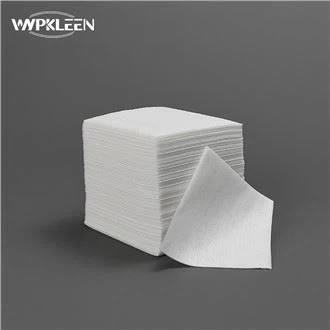
Spunlace nonwoven fabric, also hydroentangled fabric, is a fabric made through a bonding process of wet or dry fibrous webs. Spunlace uses high-pressure jets of water that penetrate the webs of fabric then hit the conveyor belt and bounce back to cause the fibers to entangle. Spunlace non-woven is a flexible entanglement that does not affect the original characteristics of the fiber. The appearance of spunlace nonwoven fabric is closer to traditional textiles than other types of nonwovens. Spunlace is high in strength and has high and rapid moisture absorption. It is not considered to be a fluffy fabric, though it is soft in texture. This fabric has good ventilation, can come in a variety of patterns and is washable.
Advantages of Spunlace Nonwoven Fabric
Softness and comfort
Spunlace nonwoven fabric is incredibly soft and gentle on the skin, making it ideal for personal care applications such as baby wipes and makeup remover wipes.
Absorbency and liquid retention
Spunlace fabric has exceptional absorbency and liquid retention capabilities, ensuring that wet wipes can effectively clean and absorb spills, dirt, and impurities.
Strength and durability
Despite its softness, spunlace fabric is remarkably strong and durable, making it resistant to tearing and abrasion, even when wet.
Versatility
Spunlace nonwoven fabric can be customized to meet specific requirements, such as thickness, weight, and texture, making it suitable for a wide range of applications.
Eco-friendliness
Spunlace fabric can be made from biodegradable and renewable materials, reducing its environmental impact and making it a sustainable choice.




Why Choose Us
Our products
Our products mainly cover Industrial Non-woven Wipers, Household Wipes, Medical Wipes, Beauty Care products, etc.
Sales team
We own a professional sales team who can service you within 24 hours.We are sure any of your inquiry will get our prompt attention and reply.
Products applications
We are a professional factory dedicated to the research and development, production, sales, and OEM service of nonwoven cleaning products which are widely used in Automotive Refinishing, Aerospace, Hospitality and Food Service, and Industrial and Manufacturing Cleaning.
Our service
We not only provide professional nonwoven solutions, but also established a perfect after-sales system, we promise to feedback to our customers in 24 hours.
Comparison Between Spunlace Vs Airlaid
Physical properties
Spunlace nonwoven fabric and airlaid nonwoven fabric have different physical properties that affect their suitability for different applications. Some of the key differences are:
Basis weight: Spunlace nonwoven fabric has a basis weight range of 30-200 gsm, while airlaid nonwoven fabric has a basis weight range of 40-800 gsm. This means that airlaid nonwoven fabric is generally thicker and more bulky than spunlace nonwoven fabric.
Tensile strength: Spunlace nonwoven fabric has a tensile strength range of 30-100 n, while airlaid nonwoven fabric has a tensile strength range of 20-70 n. This means that spunlace nonwoven fabric is generally stronger and more resistant to tearing than airlaid nonwoven fabric.
Absorbency: Spunlace nonwoven fabric has an absorbency range of 6-10 ml/g, while airlaid nonwoven fabric has an absorbency range of 8-20 ml/g. This means that airlaid nonwoven fabric is generally more absorbent than spunlace nonwoven fabric.
Softness: Spunlace nonwoven fabric is known for its high softness, while airlaid nonwoven fabric is generally less soft due to its more random and uneven structure.
Performance properties
Spunlace nonwoven fabric and airlaid nonwoven fabric also have different performance properties that affect their suitability for different applications. Some of the key differences are:
Barrier properties: Spunlace nonwoven fabric has good barrier properties against liquids, while airlaid nonwoven fabric is more porous and may not provide as much barrier protection.
Insulation properties: Airlaid nonwoven fabric has good insulation properties due to its fluffy and bulky texture, while spunlace nonwoven fabric may not provide as much insulation.
Cleaning properties: Spunlace nonwoven fabric is known for its good cleaning properties due to its soft and smooth texture, while airlaid nonwoven fabric may not be as effective for cleaning due to its more random and uneven structure.
Customizability: Both spunlace nonwoven fabric and airlaid nonwoven fabric can be customized for different applications, but spunlace nonwoven fabric may offer more flexibility in terms of fiber selection, basis weight, and finish.
Cost comparison
The cost of spunlace nonwoven fabric and airlaid nonwoven fabric depends on several factors, such as the fiber type, basis weight, production volume, and quality requirements. However, in general, airlaid nonwoven fabric is more expensive than spunlace nonwoven fabric, due to its more complex and energy-intensive manufacturing process, higher raw material costs, and limited production capacity.
Spunlace Method of Non Woven Production



Feeding cotton
During this process, workers place the raw cotton fibers on the floor beneath the machines. The feeder then automatically captures the fiber and transports it to the channel for the next process.
Foreign fiber sorting
During this process, the foreign fiber sorter removes foreign matter, small pieces of iron and small pieces of cottonseed. However, this process can only remove part of the impurities, and finally the finished product needs to be inspected to pick out the defects on the cloth surface
Carding
The carding machine stretches and relaxes the cotton fibers so that all the fibers are laid out like a sheet; they are then moved to a cross-lapping process. The main function is to remove impurities in the fibers again and comb the fibers (like combing hair) to make them neatly arranged
Cross-lapping
In the field of nonwoven fabric production at present, there are two types of laying nets. One is straight laying net, the other is cross laying net. The reason for choosing cross-laid mesh is that the tensile strength of cross-laid mesh is 1-2 times that of straight-laid mesh. But the disadvantage is that the weight is uneven
Drafting process
In this process, the cotton fiber web is stretched 2-3 times. The effect of this tension is to make the nonwoven web more uniform, with better average weight and better tensile strength in CD and MD.
Spunlace
Spunlace is the most important link in the production process. Under high pressure, water needles pass through the cotton net, making the cotton fibers more tightly entangled, and finally formed into a spunlace nonwoven fabric. The fluff and thickness of the cotton felt can be controlled by adjusting the pressure.
Roll
After spunlace, the material will be rolled into a roll.
Bleaching and drying
Since we use raw cotton fibers, what we produce is raw cotton cloth. At the moment, the cotton is gray. This process is called bleaching and drying. The gray colored cotton rolls will go into the float. In the bleaching pot, we use hydrogen peroxide to bleach under high temperature and high pressure for 4 hours. After bleaching, the laps are dried and packed.
Computer cloth inspection
We have 23 cloth inspection machines, computer controlled. If there is a defect, the machine will automatically stop and remind the workers with white light (displaying the defect on the front) and blue light (displaying the defect on the back), and the machine will resume operation after the defect is picked out.
Cut
Adjust the knife and cut according to the width requirements of different customers. When cutting, two employees will measure and record the width of the cut together to ensure that the width of the product is consistent.
Types of Spunlace Nonwoven Fabric
Viscose polyester spunlace non-woven fabric
Viscose polyester spunlace non-woven fabric with viscose fiber and polyester as raw materials, from 100% polyester to 100% viscose any ratio can be made, the conventional grammage is 35-120gsm, the effective width can reach 3.2m, it can be made into different colors and various mesh types, such as plain weave, mesh, jacquard and printing and dyeing.
Viscose polyester spunlace non-woven fabrics have the characteristics of softness, skin-friendly, high water absorption, low dandruff and solvent resistance, which make them the preferred material for wet wipes, and are widely used in mother and baby wipes, face towels, dry hair towels, bath towels, medical wipes materials and other fields.
Polyester wood pulp composite spunlace non-woven fabric
Polyester wood pulp composite spunlace non-woven fabric with wood pulp fiber and polyester as raw materials, conventional grammage of 40-100gsm, effective width up to 3.2m, can be customized plain, mesh and a variety of embossed mesh types and a variety of printing styles.
Polyester pulp plain spunlace non-woven fabric is a cost-effective multi-purpose cleaning cloth with excellent stretch resistance and low chip shedding rate, high water absorption and wear resistance, mainly used for wiping laboratory tools and electronic products, car beauty maintenance cleaning, aerospace equipment cleaning and workers' hand cleaning.
Polypropylene wood pulp composite spunlace non-woven fabric
Polypropylene wood pulp composite spunlace non-woven fabric uses wood pulp fiber and polypropylene as raw materials. We use a unique "two-step method" to produce soft wood pulp and high-strength polypropylene. The conventional grammage is 35-125gsm, the effective width is 2.1m, it can do plain weave, embossing and other mesh types, and can print and dye different colors.
Polypropylene wood pulp plain spunlace non-woven fabric is a multifunctional wiping material with soft hand feel, high liquid absorption ability and tear resistance, which is very suitable for cleaning wipes in daily life and light industry fields.
Degradable spunlace non-woven fabric
Degradable spunlace non-woven fabrics use viscose fiber, cotton fiber, bamboo fiber, lyocell fiber, wood pulp fiber and other environmentally friendly and biodegradable raw materials. Implement the concept of green development, focusing on environmental protection and degradable performance. At present, it is mainly used in wet wipes materials, mask paper, facial wipes and daily household wipes and other fields.
Materials Used in Spunlace Nonwoven Fabric

Viscose fiber
Viscose fiber is a kind of cellulose fiber, using "wood" as the raw material, extracting and reshaping the fiber molecules from natural wood cellulose to obtain cellulose fiber. In detail, viscose is made of natural fiber (wood fiber, cotton linters) as raw materials, and is made by soluble cellulose xanthate through alkalization, aging, sulfonation and other processes, and then dissolved in dilute lye and subjected to wet method spinning to make viscose.
Woodpulp fiber
Woodpulp fiber is a kind of fiber made of woodpulp as raw material, but it is different from ordinary plant fiber. It is a secondary fiber, it is a product separated from the original wood fiber, and it is mostly used in the textile field. Because it is mainly extracted from woodpulp, we call it woodpulp fiber, which is similar to paper pulp.Wood pulp fiber has high liquid absorption and it is biodegradable.


Polyester
Polyester was invented in 1941. It is a synthetic fiber obtained by spinning polyester formed by polycondensation of organic dibasic acid and glycol, referred to as pet fiber. It is a polymer compound and is currently the largest variety of synthetic fibers. It has high strength and elastic recovery ability, good wrinkle resistance and shape retention, at the same time it has good heat resistance, water absorption and oil absorption, strong and durable. Due to its characteristics, polyester is widely used in textile and nonwoven fields, mainly used as raw materials of wet wipes, cleaning wipes, and clothing.
Polypropylene
Polypropylene refers to synthetic fiber named isotactic polypropylene fiber made from propylene, a by-product of petroleum refining, non-biodegradable. It has light weight but high strength, excellent wear resistance and elastic recovery, chemical resistance is better than most fibers, and has anti-bacterial, safe and sanitary characteristics. Not only that, polypropylene is resistant to oil stains, easy to wash and dry, it is widely used in the field of oily cleaning wipes.

Spunlace Nonwoven Fabric Uses
In Medicine,spunlace non woven fabric uses
Surgical Gowns and Drapes
These are essential barriers that protect healthcare professionals and patients from the transfer of microorganisms and body fluids during surgical procedures. Spunlace nonwoven fabric is favored for its combination of fluid resistance, comfort, and breathability.
Face Masks
In the battle against airborne diseases and infections, face masks made from spunlace nonwoven fabric serve as the first line of defense. The material's ability to filter out particles while allowing for comfortable breathing is crucial.
Wound Dressings
Spunlace nonwoven fabrics are often used in advanced wound care due to their excellent absorbency and softness, which is gentle on delicate healing tissue.
Disposable Scrub Suits
These garments are worn by medical staff for hygiene reasons and to prevent cross-contamination within the healthcare environment. Spunlace nonwoven fabric ensures comfort during long hours while maintaining the integrity of a protective barrier.
Medical Packaging
Sterility in medical tools and devices is vital, and spunlace nonwoven fabric is used in packaging solutions that require a sterile barrier, combining strength with the ability to be sealed and sterilized.
In Personal Care,spunlace non woven fabric uses
Facial Masks and Cosmetic Pads
The spunlace process creates a fabric that's gentle and non-irritating, perfect for sensitive facial skin. It's used in facial masks that deliver serums and treatments efficiently, and in cosmetic pads for makeup removal and skin cleansing.
Feminine Hygiene Products
Spunlace nonwoven fabrics are used in sanitary pads, panty liners, and tampons due to their excellent fluid management properties. They help to distribute and lock in liquid, providing comfort and protection.
Baby Wipes and Wet Wipes
These products require a material that's soft enough for use on delicate skin but strong enough to clean effectively. Spunlace nonwoven fabric fits the bill perfectly, and it can be combined with lotions or other soothing solutions.
Adult Incontinence Products
For adult diapers and incontinence pads, spunlace nonwoven fabric provides a skin-friendly layer that helps to prevent irritation and manages moisture through high absorbency.
Body Wipes and Bathing Cloths:
For no-rinse cleansing options, especially in healthcare settings or for individuals with limited mobility, spunlace nonwoven fabrics are used to create pre-moistened cloths that can cleanse and moisturize the skin effectively.
In Home Decor,spunlace non woven fabric uses
Furniture Upholstery
Spunlace nonwoven fabrics are commonly used in upholstery because of their ability to mimic the appearance and texture of woven fabrics while being more cost-effective. They are used in sofas, chairs, and other furniture items, often as a base layer underneath the final upholstery fabric. This provides additional durability and support.
Wall Coverings
Spunlace nonwovens can be used as wall coverings, offering an alternative to traditional wallpapers. They are appreciated for their texture and depth, adding an aesthetic appeal that can be both visually pleasing and functional. These wall coverings can also provide soundproofing benefits depending on their thickness and material composition.
Curtains and Drapes
The lightweight and drapable nature of spunlace nonwovens makes them suitable for window treatments like curtains and drapes. They can be engineered to have varying levels of light permeability and insulation properties, making them versatile for different room environments and styles.
Table Linens and Runners
Spunlace nonwoven fabrics are used in the creation of disposable or semi-durable tablecloths, runners, and placemats. These products are particularly popular for events and catering, where quick cleanup and lower costs are beneficial.
In Industry,spunlace non woven fabric uses
Automotive Industry
In the automotive sector, spunlace nonwovens are used in both interior and exterior applications. They are used for manufacturing parts like car upholstery, headliners, and trunk liners, as well as for insulation and soundproofing materials. Their resistance to tearing and high durability make them suitable for the harsh conditions within vehicles.
Hygiene Products
Spunlace fabrics are integral to the hygiene industry. They are used in the production of items such as baby wipes, adult incontinence products, and feminine hygiene products. The softness and high absorbency of spunlace nonwovens make them ideal for sensitive skin applications.
Cleaning Supplies
The industrial cleaning market extensively uses spunlace nonwoven materials due to their excellent absorbency and strength. Products such as reusable cleaning wipes, mops, and industrial towels are commonly made from spunlace fabrics. They are effective in both dry and wet conditions, making them versatile cleaning tools.
Filtration
Spunlace nonwoven fabrics are used in air, water, and other filtration systems. Their ability to be engineered to specific pore sizes and their structural integrity make them suitable for various filtration applications, from HVAC systems in buildings to fluid processing in industrial operations.
Spunlace nonwoven fabric is a type of fabric made by entangling fibers through high-pressure water jets. To clean spunlace nonwoven fabric, you can follow these general steps:
Identify the type of stain: Before you begin cleaning, determine what type of stain you are dealing with. This will help you choose the appropriate cleaning method and product.
Vacuum: Use a vacuum with a soft brush attachment to remove any loose dirt or debris from the surface of the fabric.
Pre-treat the stain: Apply a stain remover or pre-treatment solution to the stained area and let it sit for a few minutes. Follow the instructions on the product label for best results.
Wash: Wash the fabric in cold or warm water with a mild detergent. Avoid using hot water, as it can damage the fabric.
Rinse: Rinse the fabric thoroughly with cool water to remove all the soap and any remaining stain remover.
Dry: Hang the fabric to air dry or tumble dry on low heat. Avoid using high heat, as it can damage the fabric.
Note: Always check the care label on your spunlace nonwoven fabric for any specific cleaning instructions or precautions.

FAQ
Q: What is spunlace nonwoven fabric?
Q: What is the difference between spunbond and spunlace fabric?
Q: Is spunlace biodegradable?
Q: Is spunlace safe?
Q: What are the applications of spunlace non-woven fabric?
Q: Is spunlace non woven fabric biodegradable?
Q: What is the difference between spunbond and spunlace?
Q: What are the properties of spunlace fabric?
Kind to the skin and feels soft.
Excellent hygroscopic, water-absorbing, and water-retaining properties.
Suitable for wiping water and oil (wipe-dry capability).
Q: What is the process of spunlace?
Q: Is spunlace nonwoven?
As one of the most professional spunlace nonwoven fabric manufacturers and suppliers in China, we're featured by quality products and good service. Please rest assured to wholesale cheap spunlace nonwoven fabric from our factory.
Woodpulp Polyester Spunlace Nonwoven Fabric, , Spunlace Nonwoven Fabric Roll