
What is the elongation at break of nonwoven fabric?
Leave a message

Elongation at break is a crucial mechanical property that measures the maximum amount of stretching a material can undergo before it breaks. In the context of nonwoven fabrics, this parameter is essential for understanding how the fabric will perform under stress and whether it meets the requirements of specific applications. As a nonwoven fabric supplier, we understand the significance of elongation at break and its impact on the quality and functionality of our products.
Understanding Elongation at Break
Elongation at break is expressed as a percentage and represents the increase in length of a specimen from its original length at the point of rupture. For nonwoven fabrics, this property is influenced by several factors, including the type of fibers used, the manufacturing process, and the fabric's structure.
Fiber Type
The choice of fibers plays a significant role in determining the elongation at break of nonwoven fabrics. Synthetic fibers such as polyester and polypropylene generally offer higher tensile strength and elongation compared to natural fibers like cotton. These synthetic fibers can be engineered to have specific properties, allowing for greater control over the fabric's performance. For example, polyester fibers can be treated to enhance their elasticity, resulting in nonwoven fabrics with improved elongation at break.
Manufacturing Process
The method used to produce nonwoven fabrics also affects their elongation at break. Spunbonding, meltblowing, and needle punching are some of the common manufacturing processes. Spunbonded nonwoven fabrics typically have good tensile strength and moderate elongation due to the continuous nature of the fibers. Meltblown nonwoven fabrics, on the other hand, are made from fine fibers and may have lower elongation at break but offer high filtration efficiency. Needle-punched nonwoven fabrics have a more entangled fiber structure, which can provide better dimensional stability but may reduce the overall elongation.
Fabric Structure
The density and arrangement of fibers within the nonwoven fabric influence its mechanical properties. A more densely packed fabric will generally have higher tensile strength but lower elongation at break. Conversely, a looser fabric structure may allow for greater stretching before rupture. Additionally, the presence of binders or additives can also impact the fabric's elongation. Binders can enhance the cohesion between fibers, improving the fabric's strength but potentially reducing its flexibility.
Importance of Elongation at Break in Nonwoven Fabric Applications
The elongation at break of nonwoven fabrics is a critical consideration in various applications. Here are some examples:
Hygiene Products
In the production of disposable diapers, sanitary napkins, and adult incontinence products, nonwoven fabrics with appropriate elongation at break are essential. These products need to conform to the body's movements without tearing or losing their shape. A fabric with sufficient elongation can stretch and adapt to the user's motions, providing comfort and preventing leakage.
Medical Applications
Nonwoven fabrics are widely used in medical settings, such as surgical gowns, drapes, and wound dressings. In these applications, the fabric must be able to withstand handling and movement during medical procedures without breaking. High elongation at break ensures that the fabric remains intact and provides a reliable barrier against contaminants.
Industrial Rags For Cleaning
Industrial Rags For Cleaning require nonwoven fabrics with good elongation at break. These rags are often subjected to stretching and pulling during cleaning operations. A fabric that can stretch without tearing will be more durable and effective in removing dirt and debris.
Multipurpose Paper Wipe Roll
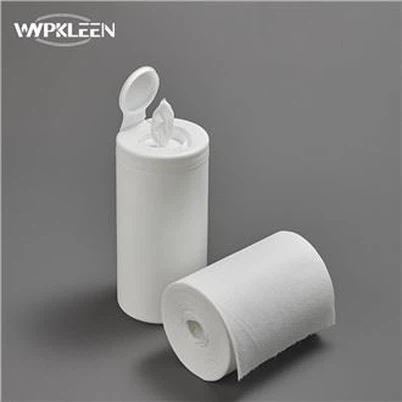
Multipurpose Paper Wipe Roll used in household and commercial cleaning also benefit from nonwoven fabrics with appropriate elongation. These wipes need to be able to stretch around objects and corners without falling apart, making them more versatile and user-friendly.
Cotton Absorbent Pad
Cotton Absorbent Pad are used for absorbing liquids in various industries. The nonwoven fabric used in these pads should have sufficient elongation to accommodate the expansion caused by liquid absorption without tearing. This ensures that the pad remains intact and continues to function effectively.
Measuring Elongation at Break
To determine the elongation at break of nonwoven fabrics, standardized testing methods are used. One of the most common methods is the tensile test, which involves clamping a specimen of the fabric between two grips and applying a gradually increasing force until the fabric breaks. The elongation at break is then calculated based on the change in length of the specimen.
The test is typically conducted according to international standards such as ASTM D5034 or ISO 13934. These standards specify the test conditions, including the specimen size, clamping method, and rate of force application, to ensure consistent and accurate results.


Controlling Elongation at Break in Nonwoven Fabric Production
As a nonwoven fabric supplier, we have the expertise to control the elongation at break of our products. By carefully selecting the fibers, optimizing the manufacturing process, and adjusting the fabric structure, we can produce nonwoven fabrics with the desired elongation properties.
We work closely with our customers to understand their specific requirements and develop customized solutions. Whether it's a high-elongation fabric for a stretchable application or a fabric with limited elongation for a more rigid use, we can tailor our products to meet the needs of various industries.
Conclusion
Elongation at break is a vital property of nonwoven fabrics that affects their performance in a wide range of applications. Understanding the factors that influence this property and being able to control it during production is essential for providing high-quality nonwoven fabric products.
If you are in need of nonwoven fabrics with specific elongation at break requirements, we invite you to contact us for a detailed discussion. Our team of experts is ready to assist you in selecting the right product for your application and ensuring that it meets your quality and performance expectations.
References
- ASTM D5034 - Standard Test Method for Breaking Strength and Elongation of Textile Fabrics (Grab Test).
- ISO 13934 - Textiles - Tensile properties of fabrics - Part 1: Determination of maximum force and elongation at maximum force using the strip method.