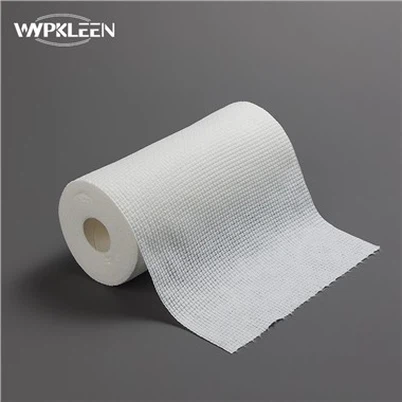
Reasons for the uneven thickness of non-woven fabrics in the production process
Leave a message
1. The blending of low-melting fiber and conventional fiber is uneven: due to the different cohesion of different fibers, generally speaking, the cohesion of low-melting fiber is larger than that of conventional fiber. If the low-melting fiber is not uniformly dispersed, the part with a small content cannot form a sufficient network structure in time, so the produced non-woven fabric is relatively thin, and compared with the low-melting fiber, the part with more fiber content forms a thicker situation.
2. Incomplete melting of low melting point fibers: This is mainly due to insufficient temperature. For non-woven fabrics with low basis weight, it is not easy to have insufficient temperature, but special attention should be paid to products with high basis weight and high thickness. For example, the non-woven fabric at the edge is usually thicker because it has enough heat. One of the reasons is that the non-woven fabric in the middle part is easy to form a thinner non-woven fabric due to insufficient heat.
3. High shrinkage rate of fiber: whether it is conventional fiber or low melting point fiber, if the hot air shrinkage rate of fiber is high, uneven thickness will also occur in the production process of non-woven fabric.
What are the causes of static electricity during the production of non-woven fabrics?
1. The external factor may be that the weather is too dry and the humidity is not enough.
2. When there is no antistatic agent on the fiber, since the moisture regain of polyester-cotton is 0.3%, in the production process of non-woven fabric, due to the lack of antistatic agent, it is easy to generate static electricity.
3. The oil content of the fiber is low, and the content of the static agent is relatively low, which will also generate static electricity.
4. The method of preventing static electricity is not only to humidify the production workshop, but also to effectively eliminate oil-free cotton in the cotton feeding stage.
What is the reason for the uneven softness and hardness of non-woven fabrics under the same processing conditions?
1. Due to the uneven blending of low-melting fiber and conventional fiber, the part with high low-melting point content is harder, and conversely, the part with low content is softer.
2. In addition, the low melting point fiber is not completely melted, which easily causes the non-woven fabric to be soft.
3. The high shrinkage rate of the fiber will also cause the problem of uneven hardness and softness of the non-woven fabric.