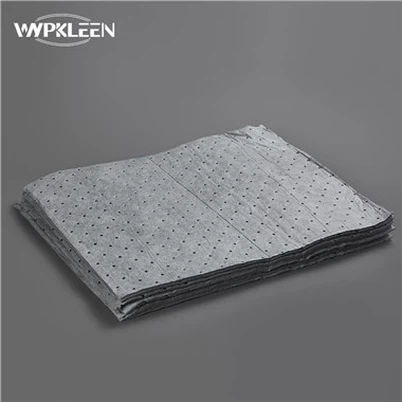

How is airlaid paper made?
Leave a message

Airlaid paper is a versatile and widely used material known for its unique properties and applications. As a leading supplier of airlaid paper, I am excited to share with you the intricate process of how airlaid paper is made. This in - depth look will not only give you a better understanding of the product but also highlight why our airlaid paper stands out in the market.
Raw Materials Selection
The first step in making airlaid paper is the careful selection of raw materials. The primary component is usually wood pulp, which can be sourced from softwood or hardwood trees. Softwood pulp provides long fibers that contribute to the paper's strength, while hardwood pulp offers shorter fibers that enhance the paper's smoothness and absorbency.
In addition to wood pulp, other natural or synthetic fibers can be incorporated depending on the desired properties of the final product. For example, cellulose fibers from cotton or hemp can be added to increase absorbency. Synthetic fibers such as polyester or polypropylene may be used to improve the paper's durability and resistance to tearing.
We take great pride in sourcing high - quality raw materials from reliable suppliers. This ensures that our airlaid paper meets the highest standards of quality and performance. By carefully selecting the raw materials, we can create airlaid paper that is suitable for a wide range of applications, from household wipes to industrial cleaning products.
Pulping Process
Once the raw materials are selected, they undergo a pulping process. In this stage, the wood chips or other fibrous materials are broken down into individual fibers. This can be achieved through mechanical, chemical, or a combination of both methods.
Mechanical pulping involves grinding the wood chips between two rotating disks or stones. This process produces a high - yield pulp but may result in fibers that are shorter and more damaged. Chemical pulping, on the other hand, uses chemicals such as sodium hydroxide and sodium sulfide to dissolve the lignin that binds the fibers together. This method produces a higher - quality pulp with longer and more intact fibers.
After pulping, the fibers are washed and screened to remove any impurities or coarse particles. The resulting pulp is then ready for the next stage of the airlaid paper manufacturing process.
Airlaid Forming
The airlaid forming process is the heart of airlaid paper production. In this step, the pulp fibers are dispersed in a stream of air and then deposited onto a moving screen or belt. Unlike traditional papermaking methods that use water as a medium for fiber dispersion, airlaid technology uses air, which allows for a more random and three - dimensional arrangement of fibers.
The airlaid forming machine consists of a series of components, including a fiber opener, a metering system, and a forming head. The fiber opener breaks up any clumps of fibers in the pulp and prepares them for dispersion. The metering system controls the amount of fibers being fed into the forming head, ensuring a consistent thickness and basis weight of the airlaid web.
The forming head creates a high - velocity air stream that carries the fibers and deposits them onto the screen or belt. As the fibers are laid down, they interlock with each other, forming a porous and absorbent web. The random orientation of the fibers gives airlaid paper its unique properties, such as high absorbency, softness, and strength.

Bonding
After the airlaid web is formed, it needs to be bonded to hold the fibers together and give the paper its desired strength and integrity. There are several bonding methods available, each with its own advantages and applications.

One common bonding method is thermal bonding. In this process, the airlaid web is passed through a heated oven or between heated rollers. The heat causes the fibers to soften and fuse together at their contact points. Thermal bonding is often used when a strong and durable bond is required, such as in industrial applications.
Another bonding method is chemical bonding. This involves applying a bonding agent, such as a latex or resin, to the airlaid web. The bonding agent penetrates the fibers and forms a chemical bond when it dries or cures. Chemical bonding can be used to achieve a wide range of properties, from soft and flexible to stiff and rigid.
Mechanical bonding is also an option. This method uses needling or hydroentanglement to physically interlock the fibers. Needling involves passing the airlaid web through a series of barbed needles that punch through the web, entangling the fibers. Hydroentanglement uses high - pressure water jets to entangle the fibers, creating a strong and cohesive structure.
Finishing
Once the airlaid paper is bonded, it undergoes a finishing process to enhance its properties and appearance. This may include calendering, embossing, or coating.
Calendering is a process where the airlaid paper is passed through a series of rollers under high pressure. This compresses the paper, making it smoother and more uniform in thickness. Calendering can also improve the paper's printability and surface finish.
Embossing is used to create a decorative or functional pattern on the surface of the airlaid paper. This can be done using heated embossing rollers or by applying pressure to a pre - engraved pattern. Embossed airlaid paper is often used in applications such as facial tissues and wipes to enhance the user experience.
Coating is another finishing technique that can be applied to airlaid paper. A coating can be used to improve the paper's water resistance, oil resistance, or printability. Common coating materials include polymers, waxes, and pigments.
Quality Control
Throughout the manufacturing process, strict quality control measures are in place to ensure that the airlaid paper meets the highest standards. We conduct regular inspections and tests at every stage of production, from raw material selection to the final finished product.

Some of the key quality parameters that we monitor include basis weight, thickness, absorbency, strength, and softness. We use advanced testing equipment and techniques to accurately measure these properties and ensure that they fall within the specified tolerances.
Any airlaid paper that does not meet our quality standards is either reprocessed or discarded. This commitment to quality ensures that our customers receive only the best - quality airlaid paper for their applications.
Applications of Airlaid Paper
Airlaid paper has a wide range of applications due to its unique properties. It is commonly used in the hygiene industry for products such as baby wipes, adult incontinence products, and feminine hygiene products. The high absorbency and softness of airlaid paper make it ideal for these applications, providing comfort and protection for the users.
In the household and cleaning sector, airlaid paper is used in products such as multipurpose paper wipe rolls. These wipes are highly absorbent and can be used for various cleaning tasks, from wiping countertops to mopping floors. You can learn more about our Multipurpose Paper Wipe Roll on our website.
Airlaid tissue paper is also popular for facial tissues and napkins. Its softness and strength make it a preferred choice for these applications. Visit our Airlaid Tissue Paper page to find out more about our tissue paper products.
In the industrial sector, airlaid paper is used for filtration, insulation, and packaging applications. Its high porosity and absorbency make it suitable for filtering liquids and gases, while its strength and durability make it a good choice for insulation and packaging materials. Our Nonwoven Airlaid Paper is widely used in these industrial applications.
Contact Us for Procurement
If you are interested in purchasing airlaid paper for your business, we invite you to contact us for a detailed discussion. Our team of experts is ready to assist you in finding the right airlaid paper solution for your specific needs. Whether you require a standard product or a custom - made solution, we have the capabilities and experience to meet your requirements.
We are committed to providing our customers with high - quality airlaid paper at competitive prices. With our state - of - the - art manufacturing facilities and strict quality control measures, you can be confident that you are getting the best product on the market.
References
- "Nonwovens: An Industry Handbook" by W. Albrecht, H. Fuchs, and W. Kittelmann
- "Papermaking Science and Technology" by G. A. Smook
- Industry reports and research papers on airlaid paper manufacturing and applications.