

How does airlaid tissue paper perform in acidic environments?
Leave a message

Hey there! As a supplier of Airlaid Tissue Paper, I often get asked about how our product performs in different environments. One question that comes up quite a bit is how airlaid tissue paper holds up in acidic environments. Well, let's dive right in and explore this topic.
First off, let's understand what airlaid tissue paper is. Airlaid tissue paper is a unique type of non - woven material. It's made by dispersing fibers in an air stream and then bonding them together. This process gives it some really cool properties, like high absorbency and good strength. You can learn more about it on our Airlaid Tissue Paper page.
Now, when it comes to acidic environments, things can get a bit tricky. Acids can react with different materials in various ways, and we need to see how airlaid tissue paper fares.
Chemical Resistance
The chemical makeup of airlaid tissue paper plays a huge role in its performance in acidic environments. Most airlaid tissue papers are made from cellulose fibers, which are relatively stable in mild acidic conditions. Cellulose is a natural polymer found in plants, and it has some degree of resistance to acids.

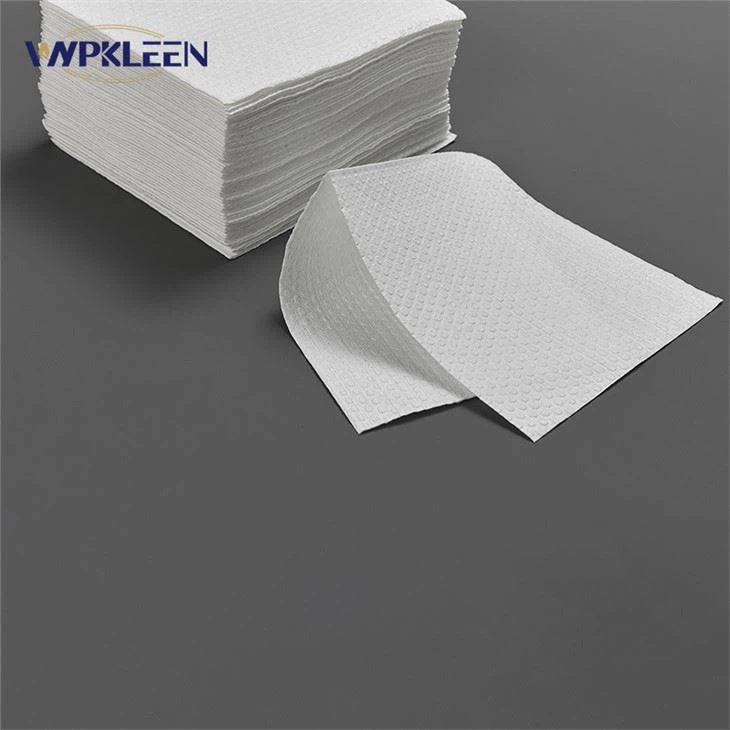
In mild acidic solutions, say with a pH ranging from 4 to 6, airlaid tissue paper can maintain its structure and functionality for a reasonable amount of time. The fibers don't break down immediately, and the paper can still perform its normal functions like absorption. For example, if you're using Airlaid Paper Wipe in a mildly acidic cleaning solution, it will work just fine for a while.
However, as the acidity increases (lower pH values), the situation changes. Strong acids, like sulfuric acid or hydrochloric acid with a pH below 2, can start to break down the cellulose fibers. The acid can react with the hydroxyl groups in cellulose, causing the polymer chains to break. This leads to a loss of strength in the paper. You might notice that the paper starts to become brittle and can tear easily.
Absorption in Acidic Conditions
One of the key features of airlaid tissue paper is its high absorbency. In acidic environments, this property can be affected in different ways.
In mild acidic solutions, the absorbency of airlaid tissue paper remains relatively stable. The porous structure of the paper allows it to soak up the acidic liquid just like it would with water or other non - acidic solutions. This makes it useful in applications where you need to clean up or absorb mild acidic spills.
But in strong acidic environments, the breakdown of the cellulose fibers can impact the absorbency. As the fibers break, the pores in the paper can collapse or become blocked, reducing the amount of liquid the paper can hold. So, if you're dealing with a strong acid spill, you might find that the airlaid tissue paper doesn't work as well as it does with milder substances.
Physical Changes
Apart from chemical and absorption changes, airlaid tissue paper also undergoes physical changes in acidic environments.
In mild acids, the paper might change color slightly. It could turn a bit yellowish as the acid starts to react with the cellulose and any impurities in the paper. But this is usually a minor cosmetic change and doesn't significantly affect the performance.
In strong acids, the physical changes are more dramatic. The paper can start to dissolve or disintegrate. You might see it turn into a mushy mess as the acid breaks down the fibers completely. This is a clear sign that the paper is not suitable for use in very strong acidic conditions.
Applications in Acidic Environments
Despite the limitations in strong acidic environments, airlaid tissue paper has several applications in mild acidic settings.
In the cleaning industry, Airlaid Paper Wipe is often used to clean surfaces that might have mild acidic residues. For example, in kitchens, there could be mild acidic spills from vinegar or lemon juice. Airlaid wipes can quickly and effectively clean these up.
In the medical field, some mild acidic solutions are used for disinfection. Airlaid tissue paper can be used to apply these solutions or to clean surfaces that have been treated with them.
In the laboratory, airlaid tissue paper can be used to clean up small spills of mild acidic chemicals. Its high absorbency and relatively good performance in mild acids make it a convenient choice.
Testing and Quality Control
At our company, we take the performance of our airlaid tissue paper in acidic environments very seriously. We conduct regular testing to ensure that our products meet the required standards.
We expose samples of our Nonwoven Airlaid Paper to different acidic solutions with varying pH levels. We measure the changes in strength, absorbency, and physical appearance over time. This helps us to understand how our products will perform in real - world acidic conditions.
Based on the test results, we can make adjustments to our manufacturing process if needed. For example, we might add certain additives to the paper to improve its acid resistance.
Conclusion
So, to sum it up, airlaid tissue paper performs reasonably well in mild acidic environments. Its cellulose - based structure gives it some degree of resistance to acids, and it can maintain its absorbency and strength for a while. But in strong acidic conditions, the paper starts to break down, losing its functionality and physical integrity.
If you're in need of airlaid tissue paper for applications in acidic environments, it's important to choose the right product. Consider the level of acidity you'll be dealing with and select a paper that can withstand those conditions.
We're here to help you make the best choice. If you're interested in purchasing our airlaid tissue paper, whether it's for cleaning, medical, or laboratory use, feel free to reach out and start a procurement discussion. We can provide you with more detailed information about our products and how they perform in different acidic scenarios.
References
- "Cellulose Chemistry and Technology" - A comprehensive book on the properties and reactions of cellulose, which helps in understanding the behavior of airlaid tissue paper in acidic environments.
- "Nonwoven Materials: Structure, Properties, and Applications" - This book provides insights into the characteristics of non - woven materials like airlaid tissue paper and how they perform under different conditions.


